
How to Read a Car Radio Spec Sheet: Screen, CPU, RAM & OS
How to Read a Car Radio Spec Sheet: Screen, CPU, RAM, and OS for Aftermarket Buyers

A sample head unit staged for parameter verification before a bulk order is released.
A car radio spec sheet is a purchasing document before it is a marketing document. Photos change, chat threads get lost, and a listing page can be edited after an order is placed — but the specification a buyer approves becomes the reference point for inspection, warranty discussion, and every repeat order that follows.
This guide decodes the four fields that carry most of the decision weight — screen, CPU, RAM and ROM, and operating system — and then adds the supporting fields that quietly determine whether a shipment of double din car radios installs cleanly or comes back. Two documented configurations are used as worked examples throughout: the TOPNAVI TS105 Universal Car Multimedia Player, a 9-inch IPS 1024×600 Android 14 unit, and the TOPNAVI TN-3036 Toyota Prado Car Multimedia Player, a 16.8-inch 2560×1440 Android 13 unit. Both appear here because their published parameters illustrate specific spec-sheet patterns, not because one is ranked above the other.
Why a Spec Sheet, Not a Product Photo, Decides the Order
A spec sheet fails a buyer in three predictable ways. The first is omission: a listing describes a touch screen car radio and never states RAM, ROM, or the amplifier channel rating, so the buyer fills the gap with an assumption. The second is conflation: working memory and storage are written as a single compact figure such as 4+64, which reads well in a title and is meaningless to a warehouse clerk checking an incoming carton. The third is unattributed vocabulary: octa-core, 2K, Hi-Res, and DSP appear without a chipset model, a resolution figure, or an amplifier part number, which makes every one of those claims impossible to verify at inspection.
Each failure has a commercial cost that shows up later than the order confirmation. A distributor buying an aftermarket car radio on a vague memory specification discovers the gap when a customer installs navigation and music apps at the same time. A retailer discovers the gap when a return arrives with the note that the unit is not the version advertised. Neither problem is a manufacturing defect; both are documentation defects, and both are avoidable at the quotation stage.
The practical test is simple: every line on the sheet should be falsifiable by someone standing next to an open carton. Screen diagonal can be measured. Resolution can be read from the system information screen. RAM and ROM can be displayed in settings. The operating system version can be photographed. A certification number can be matched against a certificate. If a claim cannot survive that test, it belongs in the marketing copy and not in the purchase order.
Industry Background: Why Head Unit Specs Got Harder to Read
The aftermarket car radio category is organised first by form factor. A single din car radio occupies a one-slot dashboard opening, a double din car radio occupies a two-slot opening, and a universal unit is designed to fit a broad range of vehicles rather than one platform. The published product range reflects this directly: the TOPNAVI TN-9359 is listed as a 2 din universal Linux unit, the TN-UK1105 is listed as a universal 1DIN dashboard mount unit, the TS105 is listed with universal car fitment, and the TN-3036 is listed with 2DIN universal installation. Form factor is the first filter, because no specification further down the sheet matters if the chassis does not enter the dashboard.
Scale explains why so many buyers are reading these sheets at once. Grand View Research reports that the Double DIN form factor accounted for 44% of car stereo revenue in 2025, and Mordor Intelligence places the global car audio market at USD 12.24 billion for the same year. Those figures describe the category, not any individual supplier, but they explain the direction of catalogue development: the double din car radio is where most aftermarket purchasing decisions now land.
Two further shifts made spec sheets harder to read. Screens grew: a 9-inch 1024×600 IPS panel and a 16.8-inch 2560×1440 IPS panel now appear in the same supplier catalogue, and they are not comparable on any single number. Operating systems also split. Android head units in the current range span Android 14, Android 13, Android 12 and Android 11, while Linux units such as the TN-9359, TN-M9 and TN-M11 serve applications where an app ecosystem is not the priority. A sheet that says only Android therefore answers almost nothing.
Finally, customisation turned the spec sheet into a contract. OEM and ODM production are both offered, with customisation covering logo, UI theme, boot animation, app pre-installation, language, DSP tuning, button light colour, panel colour, screen size and resolution, RAM and ROM, wired or wireless CarPlay, 4G module, GPS and Beidou, AHD camera, steering wheel control, CAN protocol, vehicle adaptation, packaging, and firmware OTA. Each of those is a line item a buyer can specify, and each one is a line item a buyer can fail to specify.
The Four Core Fields, Decoded
Screen, CPU, RAM and ROM, and operating system appear on nearly every aftermarket car radio sheet. Read in the right order, they answer four different questions: what the driver sees, what the unit can execute, what it can hold, and what software environment it runs in.
Screen: Diagonal, Resolution, Panel, and Touch Are Four Different Claims
A screen specification contains four independent claims, and a sheet that gives only one of them is incomplete. The diagonal is the physical size in inches. The resolution is the pixel matrix, written as width × height. The panel type describes the display technology. The touch layer describes how input is registered, and the material description usually indicates whether the front surface is tempered glass.
The TS105 illustrates a complete screen block: 9 inch, 1024×600, IPS, capacitive touch screen. The TN-3036 states 16.8 inch, 2560×1440, IPS touch screen. These are not two points on a single quality scale; they are two different product decisions. A buyer comparing them should record both numbers and resist the instinct to treat the larger diagonal as automatically superior, because the physical size and the pixel matrix have to be evaluated together, and neither one describes brightness, viewing angle, or daylight legibility on its own.
Panel terminology deserves a follow-up question rather than a conclusion. IPS, QLED and OLED all appear across the published range — the TS10 lists IPS or QLED as options, the TN-X23 lists a QLED capacitive touch screen, the TN-X80 lists an OLED display, and the TN-UK1105 lists a 2K OLED capacitive touch screen — so a buyer should confirm which panel is fitted to the exact SKU being quoted and request the display specification for that unit. Where a model offers several resolutions, the sheet must state which one applies to the order: the TS10, for example, is listed at 1024×600 with 1280×480, 1280×720 and 1920×1080 as options, and a purchase order that names only the model number leaves that choice open.
CPU: Why 'Octa-Core' Is Not a Specification on Its Own
Core count is the most quoted and least informative CPU claim on an aftermarket car radio sheet. A usable processor line contains four elements: the chipset model, the core configuration, the clock speed, and where available the process node. The TS105 lists a UIS7865 octa-core CPU. The TN-3036 lists an 8-core CPU. Both statements are true and both are incomplete in different ways, which is exactly the point.
Other models in the same catalogue show what a fuller entry looks like. The TS10 lists a Unisoc UIS7862S 8-Core chipset with a 2×A75 + 6×A55 configuration, 2.0GHz clock and 12nm process. The TN-X23 and TN-X80 both list a UIS8581A 8-core chipset at 1.6GHz. The TN-UK1105 lists a TS18L 8-core Cortex-A55 at 1.6GHz. Reading these side by side is useful precisely because it shows how much information an octa-core headline hides: the same core count can sit behind different chipset families, different core mixes, and different clock speeds.
The procurement rule follows directly. When a quotation states only a core count, ask for the chipset model and the clock speed, and write both into the RFQ. Do not convert core count into a performance expectation at the evaluation stage — processor behaviour in a vehicle also depends on memory, thermal design, and software build, none of which is captured by the word octa-core.
RAM and ROM: Two Numbers That Get Confused in Every Second RFQ
RAM is working memory: it holds what the unit is doing right now. ROM is storage: it holds the operating system, pre-installed applications, and user files. They perform different jobs and they fail in different ways, which is why a sheet that merges them into one figure is a documentation risk rather than a convenience.
A complete memory line states both capacity and type. The TS10 is documented with LPDDR4X memory at 4GB, 6GB or 8GB and eMMC (MLC) storage at 64GB, 128GB or 256GB. The TN-3036 states 4GB RAM and 64GB ROM. The TN-X23 states 4GB RAM plus 64GB ROM. The TN-AI47 CarPlay box, a different product type, states 2GB RAM and 16GB ROM. Type matters alongside capacity: LPDDR4X and eMMC (MLC) are specification facts a buyer can compare, while an unqualified gigabyte figure is not.
Two practical notes follow. First, stated ROM is not the same as user-available storage, because the operating system build and pre-installed applications occupy part of it. Second, a missing memory line is a finding, not a detail: the publicly listed TS105 parameters cover the 9-inch IPS screen, Android 14, the UIS7865 octa-core CPU, connectivity and CarPlay support, but do not state RAM or ROM, so a buyer sourcing that model should request both figures in writing before approval. RAM and ROM are also listed among the customisable parameters, which means the approved figure must be tied to the specific order rather than to the model name.
Operating System: Version, Branch, and Update Path
The operating system line tells a buyer which software family the unit belongs to and how it will be maintained. Across the current range the Android family spans Android 14 on the TS105, Android 13 on the TN-3036, TN-X23 and TN-X80, Android 12 on the TS10, and Android 11 on the TN-AI47. The Linux family is represented by the TN-9359 universal 2 din unit, the TN-M9 motorcycle navigation unit and the TN-M11 motorcycle navigation unit, all listed with a Linux system.
A version number alone is not the whole claim. For Android units, buyers should also record whether Google services and app installation are supported for the target market, what is pre-installed, which languages are loaded, and whether firmware OTA updates are part of the agreement — firmware OTA is explicitly listed among the available customisation items. For Linux units, the relevant questions are different: which navigation and CarPlay functions are built in, and how updates are delivered. The TN-M11, for example, is documented with CarPlay, Android Auto, wireless mirror link and GPS tracking on a Linux system.
Software version is a specification fact, not a performance ranking. Two Android units from the same supplier can differ in screen, processor, memory, and software build at the same time, which is why the OS line should be read together with the three fields above rather than in isolation.
Supporting Fields That Quietly Change the Verdict
Connectivity. The connection line should separate Wi-Fi, Bluetooth, cellular and physical ports. The TS105 lists USB, built-in WiFi, wireless, Bluetooth and a 3G/4G SIM card slot, with built-in wireless CarPlay and Android Auto. The TN-3036 lists Bluetooth 5.0, built-in GPS, FM/AM RDS, and wireless as well as wired CarPlay and Android Auto. Bluetooth version, SIM capability and the number of USB ports are all checkable at inspection and all too often left off the sheet.
Audio output. The TN-3036 lists an audio output of 4×50W, and the TN-X23 lists the same 4×50W figure. The TS10 goes further, naming a ROHM BU32107EFV DSP, a 48-band EQ, a TDA7851 amplifier rated at 4×48W maximum and a signal-to-noise ratio above 90dB. When a sheet gives only a wattage, ask whether the figure is peak or continuous and ask for the amplifier part number, because an unattributed number cannot be reconciled between two suppliers.
Thermal and installation. The TN-3036 states an operating temperature of -30°C to 75°C and a working voltage of DC 12V; the TS10 states a working range of -30°C to +75°C; the TN-X23 lists a full metal body with a built-in cooling fan. Installation language matters as much as the number: 2DIN universal, universal 1DIN dashboard mount, and steering wheel plus touch control describe three different installation realities.
Certification. The TS105 lists E-mark, CE and FCC. The TN-3036 lists CE and FCC. A certification name is a starting point, not an answer — the certificate itself must be checked against the SKU, as the next section explains.
A Ten-Step Reading Order for a Standard Spec Sheet
The order below reflects how an incoming shipment is actually checked, not the order in which a supplier happens to write the sheet.
- Confirm form factor and fitment first. Single din or double din, universal or vehicle-specific. Everything else is irrelevant if the chassis does not fit.
- Record screen diagonal and resolution as two separate fields. Never accept one without the other.
- Name the panel and the touch layer. IPS, QLED or OLED, and capacitive touch with the stated front material.
- Extract four CPU elements. Chipset model, core configuration, clock speed, and process node where available.
- Split RAM from ROM and note the type. For example LPDDR4X memory and eMMC storage rather than a merged figure.
- Write down the OS version, the update path and the language set. Include whether firmware OTA is part of the agreement.
- Map the connectivity block. Wi-Fi, Bluetooth version, SIM support, USB count, and wired versus wireless CarPlay and Android Auto.
- Attribute the audio line. Amplifier part number, channel rating, DSP, and equaliser capability.
- Match every certification name to a certificate. Check the model or series listed, the standard and its version, the issuing body and the validity period.
- Convert the sheet into acceptance criteria and validate with a sample. A parameter that is not in the acceptance list will not be inspected, and a parameter that is not inspected will eventually be disputed.
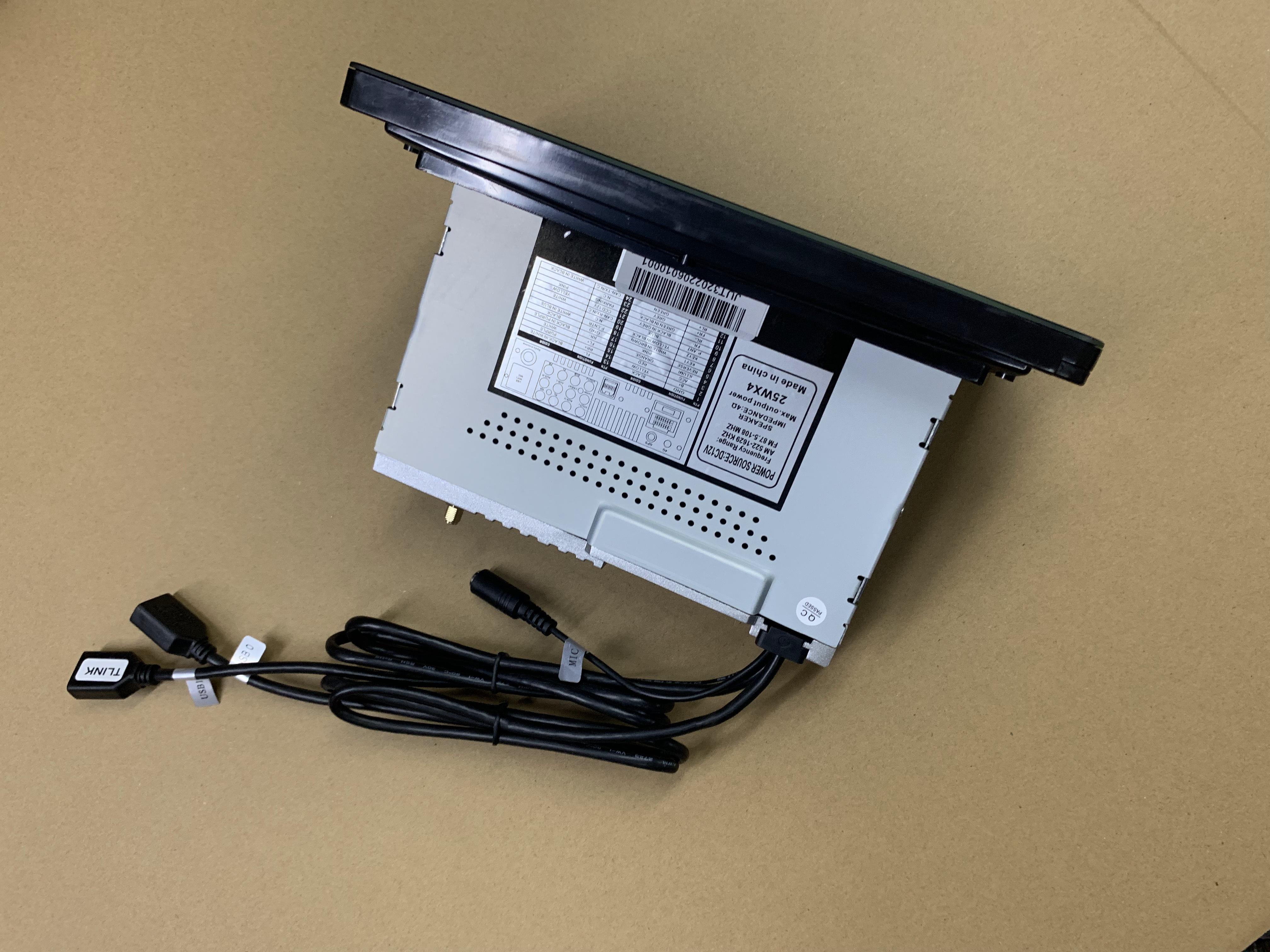
Sample units are the point at which a written specification becomes an inspectable one.
Use Cases: The Same Sheet Reads Differently by Buyer Type
Four buyer profiles read the same document with different priorities, which is why a supplier sheet should be annotated rather than simply forwarded.
Online auto parts retailers. The specification becomes customer-facing copy, so the loss risk sits in translation, not in engineering. Screen size and memory are the two claims most likely to be misread by an end customer, and the sheet should be rewritten into plain language before it reaches a product page. A US online auto parts retailer selling to pickup truck and SUV modification enthusiasts ordered 1,500 units over a three-year period, which illustrates how a repeat retail programme depends on a stable, repeated specification rather than a one-off description.
Installation shops and modification chains. Fitment, steering wheel control, CAN protocol and panel dimensions outrank processor claims, because a unit that does not integrate costs labour time. For these buyers the sheet should be read with the vehicle adaptation and steering wheel control lines treated as mandatory fields.
OEM and fleet programmes. Operating temperature, certification scope, firmware OTA and language set move to the top. A unit destined for factory pre-installation must be documented against the same evidence standard as the rest of the vehicle electronics, and the certificate — not the certification logo — is the reference.
Private-label and distributor brands. The spec sheet and the customisation list merge. Logo, UI theme, boot animation, app pre-installation, language, DSP tuning, panel colour, packaging and firmware OTA are all order-specific parameters, and any of them can drift between the sample and the bulk shipment unless they are written down.
Comparison Table: Four Documented Configurations Side by Side
The table below reproduces published parameters only. Where a field is not stated in the available specification, it is marked as such rather than estimated, because an honest gap is more useful to a buyer than a filled-in guess.
| Model | Screen and panel | OS and CPU | Memory | Connectivity and audio | Installation and compliance |
|---|---|---|---|---|---|
| TS105 | 9 inch, 1024×600, IPS capacitive touch | Android 14; UIS7865 octa-core | Not stated in the available specification | USB, built-in WiFi, wireless, Bluetooth, 3G/4G SIM; built-in wireless CarPlay and Android Auto; audio rating not stated | Dashboard mount, universal fitment; E-mark, CE, FCC |
| TN-3036 | 16.8 inch, 2560×1440, IPS touch screen | Android 13; 8-core | 4GB RAM, 64GB ROM | Bluetooth 5.0, built-in GPS, FM/AM RDS; wireless and wired CarPlay and Android Auto; 4×50W audio output | 2DIN universal, steering wheel and touch control; CE, FCC; -30°C to 75°C |
| TN-X23 | 12.3 inch Diamond QLED capacitive touch, double knob design | Android 13; UIS8581A 8-core, 1.6GHz | 4GB RAM + 64GB ROM | 4G SIM support, built-in WiFi; wireless CarPlay, wired Android Auto; 4×50W audio output | 2DIN universal fit; full metal body with built-in cooling fan |
| TN-UK1105 | 11.5 inch 2K OLED capacitive touch, 2000×1200 | Android 13 (8-core); TS18L 8-core Cortex-A55, 1.6GHz | Not stated in the available specification | USB, built-in WiFi; mirror link, Android Auto, DSP, Hi-Res Audio, built-in microphone | Universal 1DIN dashboard mount; 1-year warranty |
Read across the rows and a pattern appears: the two models with a complete memory line state it explicitly, while the two models without one leave a gap the buyer must close. That gap is the single most common cause of an order that cannot be inspected against its own paperwork.
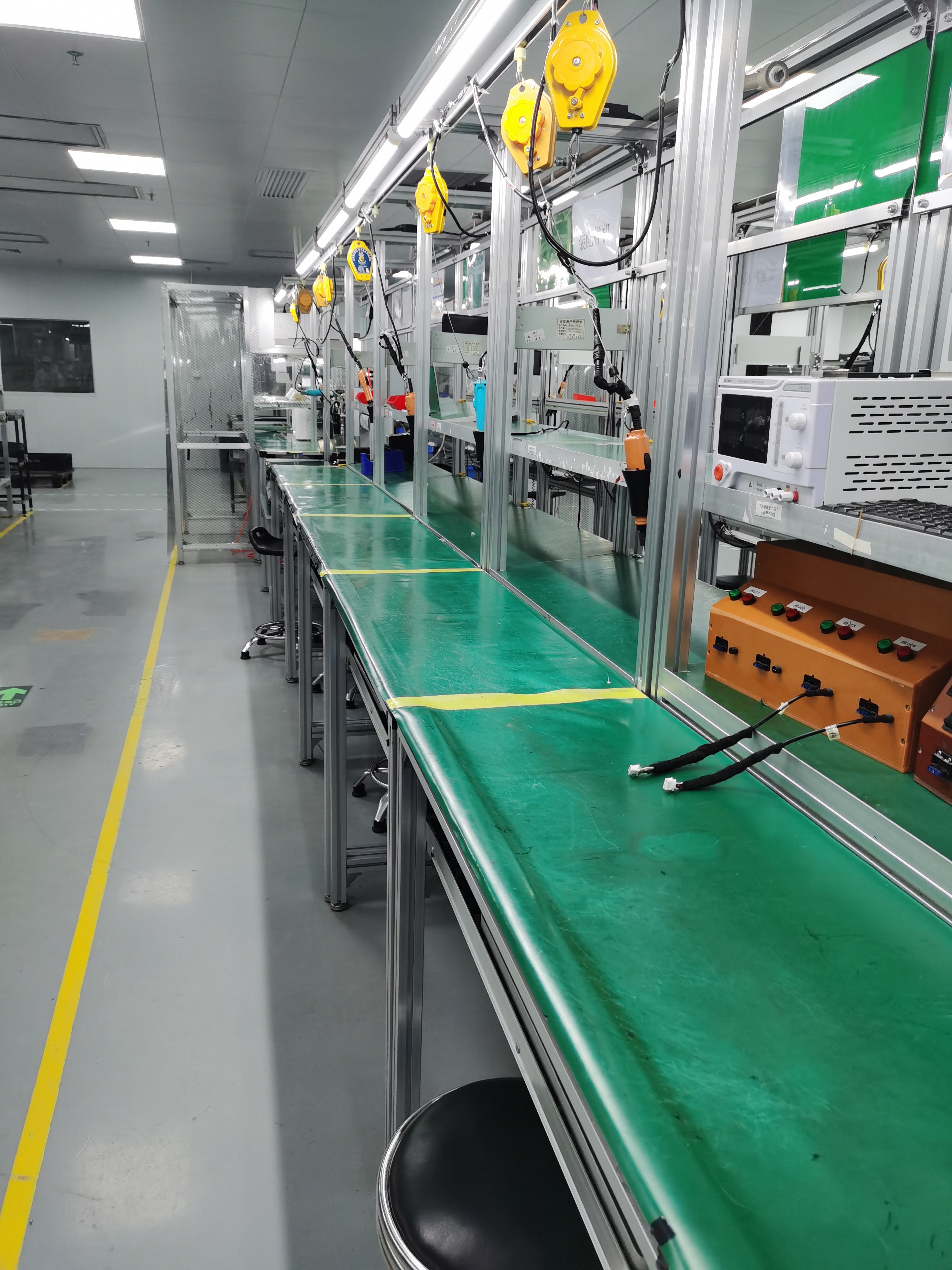
Production line for car multimedia players, where the parameters on the approved sheet are applied to the build.
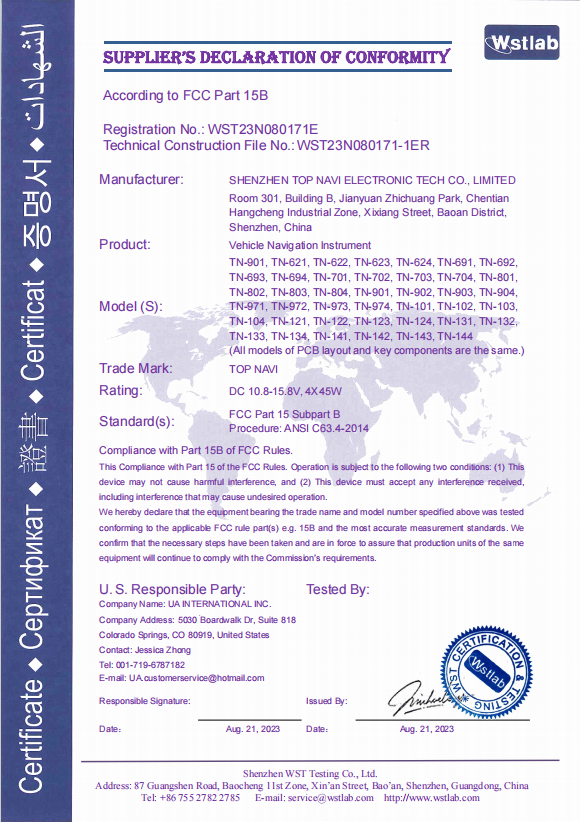
A certification logo on a spec sheet should always lead back to the certificate itself, including the covered models and the standard version.
Frequently Asked Questions
Which spec-sheet fields should be checked against the compliance certificate?
Match the model or series, the standard and its version, the issuing body, and the validity period — not just the logo. The FCC Part 15B certificate WST23N080171E, issued by Shenzhen WST Testing Co., Ltd, covers the full series of Vehicle Navigation Instruments listed on the certificate, on the basis that all covered models share the same PCB layout and key components. The CE-EMC certificate WST23N080170E covers the listed vehicle navigation instrument series against EN 55032:2015+A1:2020 and EN 55035:2017+A11:2020. The ECE E24 type-approval certificate E2410R06/024547*00, issued by NSAI, covers the listed car multimedia player series against UN/ECE Regulation No. 10 (06 series of amendments). The ISO 9001 certificate SW25Q20244R1S, issued by Shanghai Sailway Certification Co., Ltd, covers the R&D, production and sales of car audio-visual systems, car multimedia players and GPS navigation systems, and is valid from 2025-03-11 to 2028-03-10. The TS105 and TN-3036 both appear among the related products of these certifications, but the buyer should still confirm that the exact SKU being ordered falls inside the covered series.
How should RAM and ROM be compared between two Android car radios?
Compare capacity and type separately, and never accept a merged figure. The TS10 documents LPDDR4X memory at 4GB, 6GB or 8GB with eMMC (MLC) storage at 64GB, 128GB or 256GB. The TN-3036 documents 4GB RAM and 64GB ROM. The TN-X23 documents 4GB RAM plus 64GB ROM. The TN-AI47 CarPlay box documents 2GB RAM and 16GB ROM. Where a sheet states only storage, ask for working memory; where it states only working memory, ask for storage; where it states neither, the figure has to be added to the RFQ before the specification is approved.
Which specification items drive the cost of an aftermarket car radio?
Cost follows the configuration lines on the sheet: screen size, resolution and panel type; chipset family and clock speed; RAM and ROM capacity and memory type; connectivity modules including 4G, dual-band WiFi and Bluetooth; audio components such as DSP and amplifier; certification and testing scope; and any customisation, from logo and UI theme to packaging and firmware OTA. Because these are configuration variables, a retail listing price from a single seller is not a procurement benchmark — it reflects one configuration, one market and one set of commercial terms. The reliable approach is to fix the specification first and request a quotation against that fixed specification.
How can a buyer validate a spec sheet before a bulk order?
Validation is a documented sequence rather than a single check. Sample confirmation is required before bulk production, so the approved sample becomes the physical reference for the order. Before shipment, production applies a 100% full function test, customer on-site inspection is accepted, and third-party inspection through bodies such as SGS or TUV is supported. Customisable items — logo, UI theme, boot animation, language, DSP tuning, panel colour, packaging and firmware OTA — should all be frozen at the sample stage, because they are the parameters most likely to drift between a sample and a production batch.
What lead time applies once a specification is approved?
For OEM and ODM orders the typical lead time is 7–15 days, with production capacity supported by a monthly output figure of 30,000 units. Lead time should be read together with the specification rather than on its own: a configuration that adds custom panel colour, a specific memory combination, a language pack or firmware OTA involves steps that a standard configuration does not. The practical sequence is to approve the specification, confirm the sample, place the production order, and then plan inspection and shipping against the confirmed lead time.
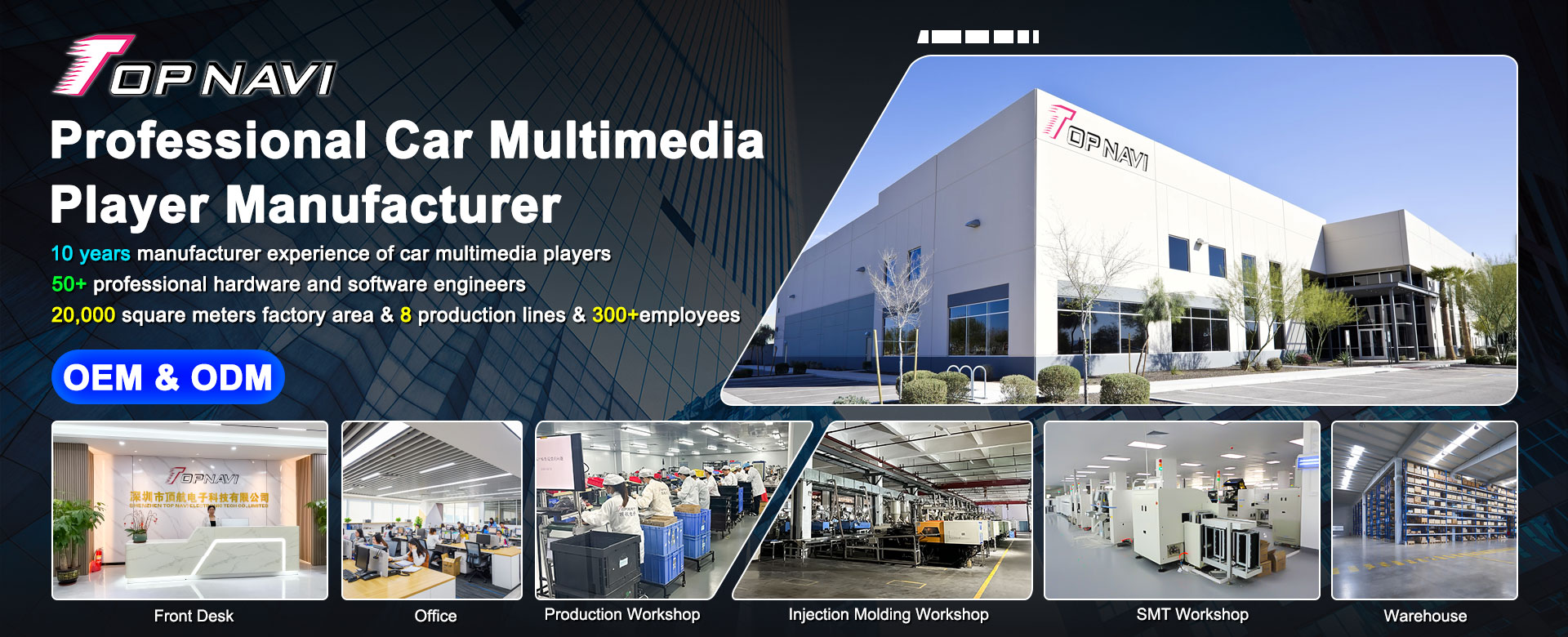
Shenzhen Top Navi Electronic Tech Co., Limited, founded in 2014, manufactures car multimedia players and GPS navigation systems in Shenzhen, China.
Conclusion: Turn the Spec Sheet Into an Approved Document
Reading a car radio spec sheet is a sequence, not a vocabulary test. Fix the form factor, separate screen diagonal from resolution, demand a chipset model behind the core count, split RAM from ROM and name the memory type, and record the operating system version together with its update path. Then close the remaining gaps — connectivity, audio attribution, thermal range and certification scope — before the sheet becomes a purchase order.
The two examples used throughout this guide show why the discipline matters. The TS105 states a complete screen block, a named CPU and a full connectivity set, but does not publish RAM or ROM, so that figure has to be requested. The TN-3036 states memory, audio output and thermal range, but describes its processor only as 8-core, so the chipset has to be requested. Neither gap is a defect in the product; both are gaps in the document, and both are closed by asking before the order is placed rather than after the carton is opened.
TOPNAVI (Shenzhen Top Navi Electronic Tech Co., Limited) manufactures Android car radios, car head units, motorcycle navigation units, CarPlay boxes and related in-vehicle products in Shenzhen, China, and supplies OEM and ODM programmes across EU, US, Brazil, India, South Korea and Japan markets. Buyers who want to compare published parameters across the full range, or who need a specification confirmed in writing before a sample order, can download the product catalogue or send the required configuration directly.
Download the catalogue: TOPNAVI product catalogue (PDF). For specification confirmation, sample requests or quotation against a fixed parameter list, contact the team at sales@topnaviauto.com or via WhatsApp at +86 150-7094-1278.
Have Questions or Need More Details?
Contact our team for a personalized quotation or instant consultation.
Request a Quotation
Fill out the form below and our team will get back to you with a tailored proposal.
WhatsApp Direct Chat
Prefer to chat in real-time? Message us on WhatsApp for instant assistance & quick answers.
- Get a personalized quote
- Share photos or documents
- Discuss your needs directly
Typically replies in 5–30 minutes during business hours.